
Bitcoin’s realized volatility has fallen to its lowest level on record, according to data from Fidelity Digital Assets.
“Realized volatility” reflects how much an asset’s price fluctuates over a given period — in this case, one year. At 42%, Bitcoin is currently showing extremely low volatility compared with its past, when annual volatility frequently exceeded 100% or even 200% in its early years. In other words, Bitcoin has become… “boring.” This unusual calm suggests the world’s largest cryptocurrency is gradually losing its “casino-like” character, with price movements now confined to a much narrower range instead of the sharp 20–30% daily swings seen in previous cycles.
However, volatility in financial markets is typically cyclical, shifting from periods of high turbulence to periods of low stability and then back again. The drop to 42% indicates strong compression in the market — similar to a spring being tightly coiled and ready to release energy.
A signal of a new all-time high?
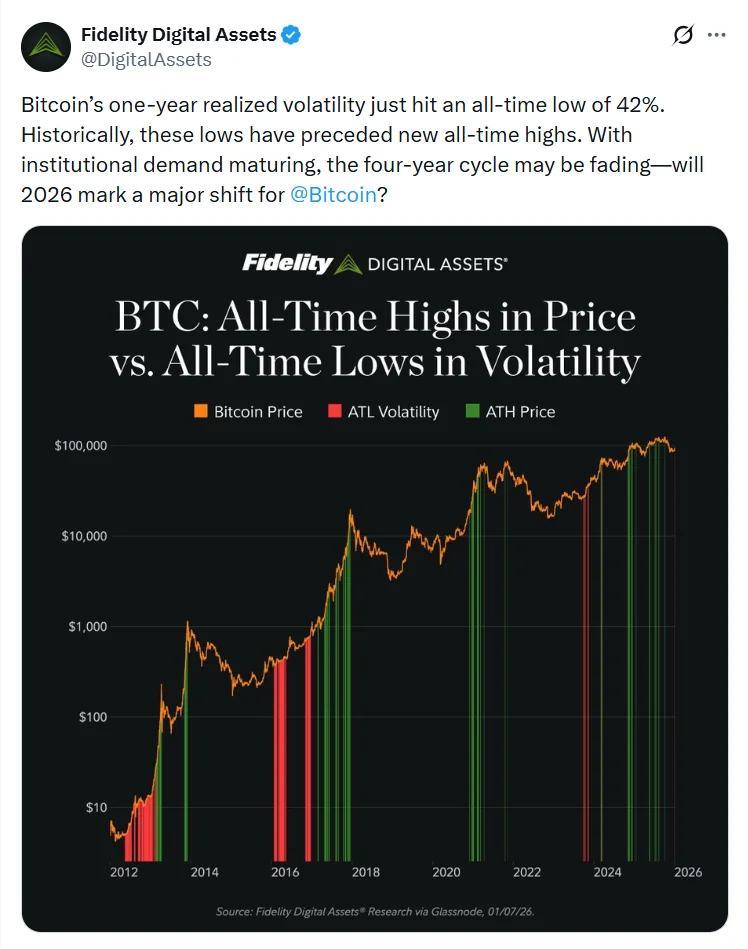
Fidelity Digital Assets also highlights a rare and historically bullish signal: Bitcoin has become unusually stable. From a technical perspective, periods when volatility hits all-time lows (ATL) have often acted as a precursor to all-time-high (ATH) prices. For example, the period of low volatility in 2016 preceded the major bull run to 20,000 USD in 2017.
The chart presented by Fidelity shows a new cluster of “ultra-low volatility” signals emerging again. Their argument is that this prolonged phase of sideways, stable movement may represent an accumulation period in which energy is building for the next major breakout.
Even so, history does not always repeat itself. Bitcoin is currently trading around 90,789 USD and is still struggling to recover after a recent correction, having failed to break above the 95,000 USD level.