
Starting January 28, South Korea will enforce new regulations restricting access to overseas cryptocurrency exchanges on Google Play. This move could prevent users from downloading or updating apps from major platforms such as Binance and OKX.
New Rules: Not Just Filing, But Official Approval Required
Under the new policy, foreign exchanges must submit a Virtual Asset Service Provider (VASP) report to the Financial Intelligence Unit (FIU) and obtain official approval before their apps can remain listed on Google Play. Google emphasized that filing the report alone is insufficient; exchanges must prove that the FIU has reviewed and accepted it.
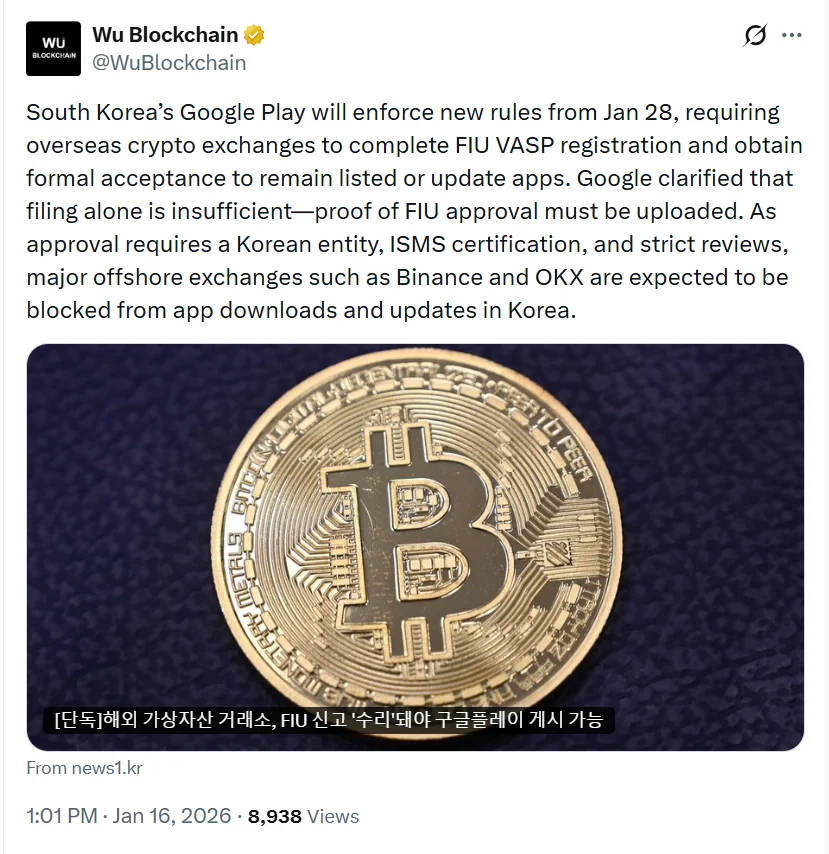
To secure FIU approval, a crypto exchange must:
- Establish a local company in South Korea.
- Obtain ISMS security certification.
- Pass strict anti-money laundering checks.
Industry experts say these requirements are nearly “impossible” for overseas exchanges to meet. As a result, even global giants are likely to be blocked from downloads and updates once the rules take effect. Existing users may also face disruptions, since most trading apps require regular updates to function properly.
Impact on Korean Investors
Domestic exchanges such as Upbit and Bithumb dominate spot trading but restrict derivatives and futures products. This has driven many Korean investors to rely on overseas platforms for advanced trading options. If foreign apps are removed or prevented from updating, access to these services will become increasingly limited.
South Korea’s rules are part of Google’s broader global effort to align crypto apps with local regulations. Similar requirements already exist in the U.S., EU, Japan, Canada, and Hong Kong, where exchanges must be registered or licensed with local regulators to list apps on Google Play.
In South Korea, only exchanges and software wallets that have fully filed and received FIU approval for their VASP report can remain listed. This sets a high barrier that few—if any—foreign exchanges are expected to clear in the near future.