

Hyperliquid is quietly emerging as one of the most liquid venues for crypto price discovery, even overtaking major exchanges such as Binance. Recent data from Bitcoin perpetual contracts shows that Hyperliquid offers tighter spreads and higher trading volumes, signaling increasingly strong liquidity conditions.
According to the development team, this milestone is driven by the continuous efforts behind HIP-3 — an upgrade designed to improve market efficiency and liquidity provision across the platform.
HIP-3 Pushes Open Interest to Record Highs
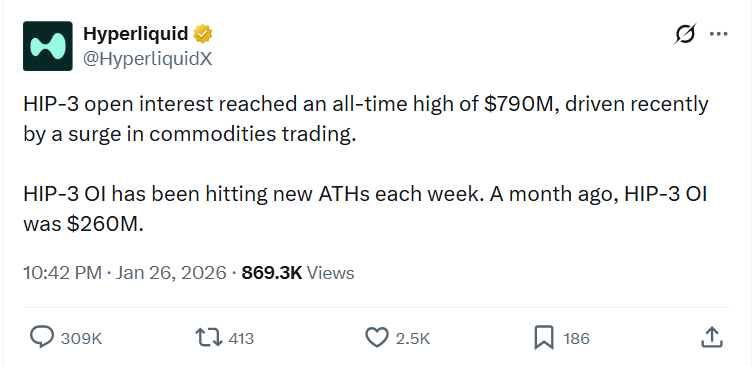
The main engine behind Hyperliquid’s liquidity growth is the HIP-3 protocol. Open Interest (OI) under HIP-3 has surged to an all-time high of $790 million, up sharply from around $260 million just one month ago.
This growth has been fueled largely by a spike in commodities and traditional derivatives trading, pushing HIP-3 OI to repeated weekly records. HIP-3 is a system upgrade that expands Hyperliquid’s trading capacity, not only for crypto but also for traditional finance (tradfi) instruments.
Bridging Crypto and Traditional Finance
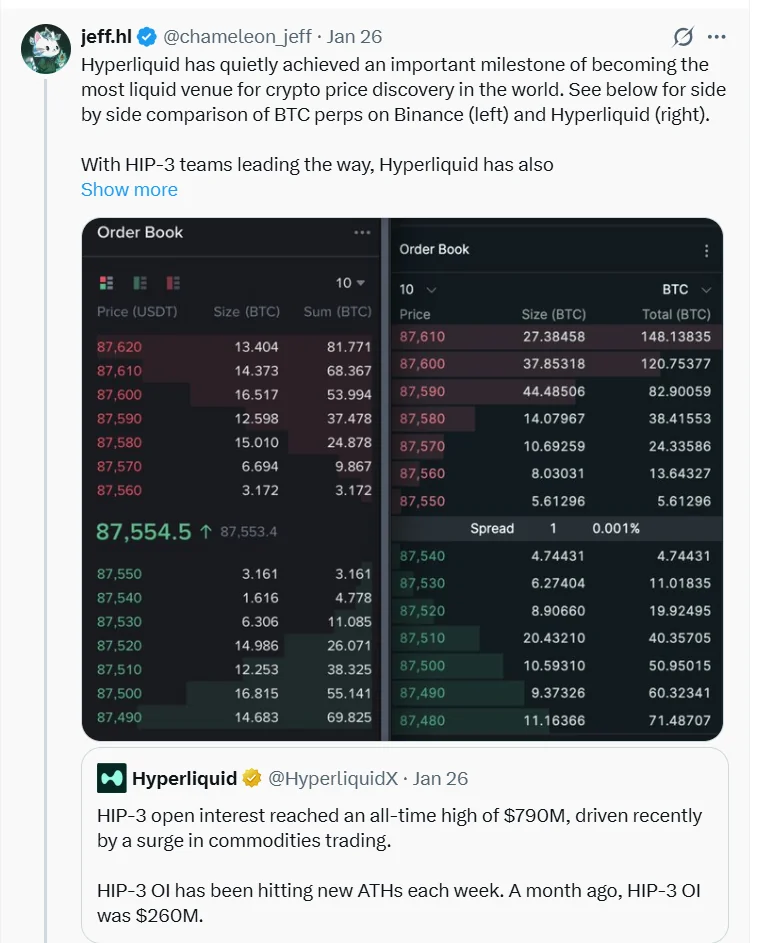
Despite the impressive liquidity figures, directly comparing order book depth between Hyperliquid and other exchanges can be misleading.
Several perpetual traders, including @Crypto_Noddy, point out that Hyperliquid uses a “speedbump” mechanism, where order cancellations are prioritized over taker executions. This allows makers to post very large orders without necessarily intending to fill them.
In side-by-side BTC perp comparisons with Binance, Hyperliquid displays significantly deeper liquidity and dense clusters of large orders around the $87,600 level. However, displayed depth does not always reflect the amount of liquidity that can actually be executed.
Order Book Mechanics May Overstate Real Liquidity
Because of the speedbump, makers can pull orders very quickly before being hit. While this reduces the risk of being picked off, it also means visible liquidity can vanish almost instantly.
According to traders, real trading activity suggests that executable liquidity on Hyperliquid may be far lower than the order book implies. For example, during a recent short-term ETH move, Hyperliquid processed only about $2.5 million in volume, while other exchanges with visually thinner books absorbed much larger trades.
Why This Matters
Hyperliquid is becoming a major liquidity hub for both crypto and tradfi. However, its order book mechanics mean that “visible” liquidity is not always “tradable” liquidity. Traders should factor in execution risk and potential slippage when placing large orders.