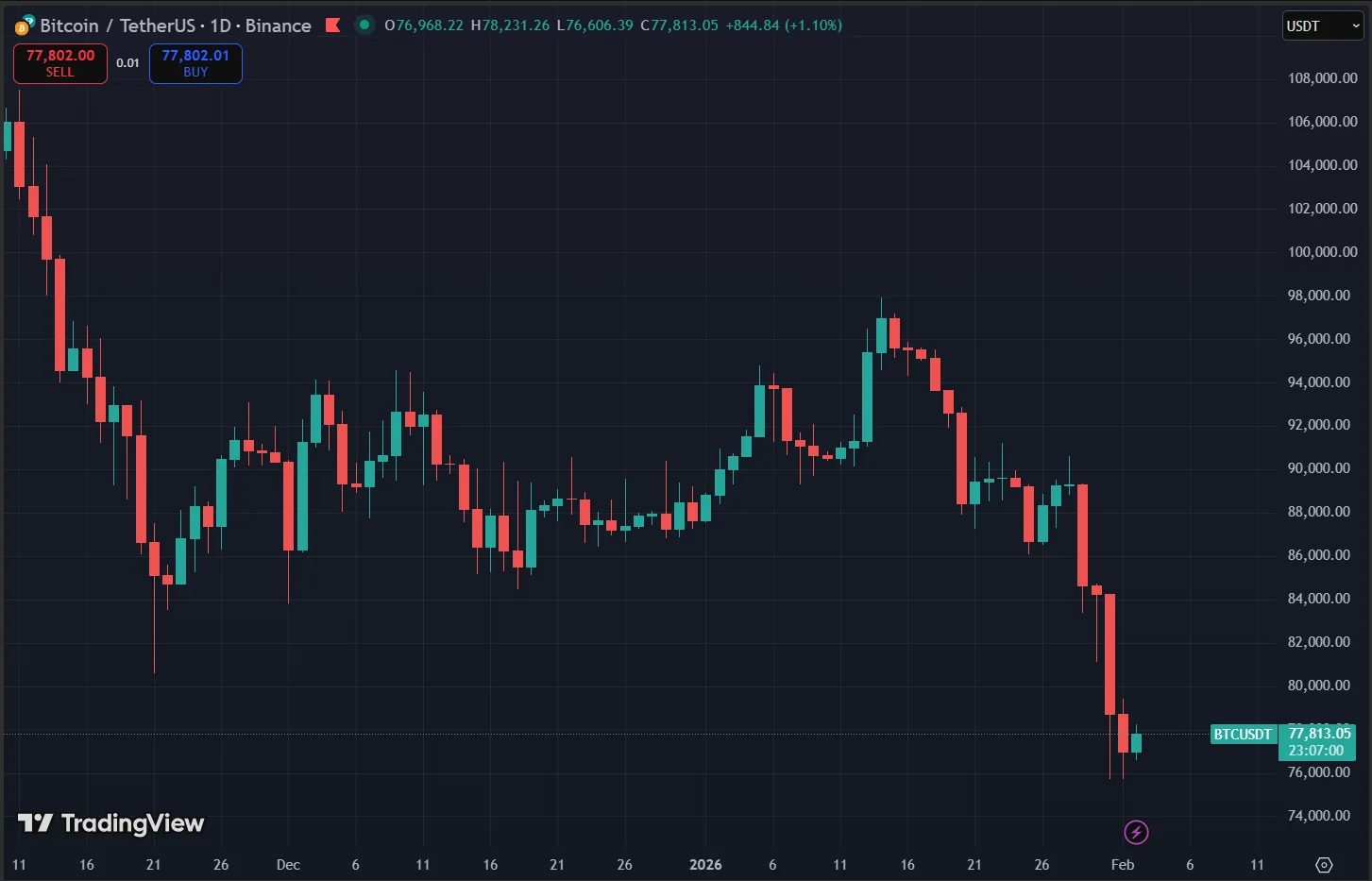
Just a few weeks ago, Bitcoin was trading comfortably above the $95,000 mark, and the crypto community was enthusiastically discussing the possibility of reaching six-digit prices for the first time in 2026. However, that optimistic scenario quickly faded as sellers suddenly took control, dragging the market into a deep winter correction.
Instead of continuing its rally, Bitcoin suffered a series of sharp sell-offs, sending the price down to multi-month lows. From its peak near $95,500 on January 18, BTC has lost around $20,000 in just two weeks, pushing overall market sentiment into a highly pessimistic zone.
Fear & Greed Index Plunges
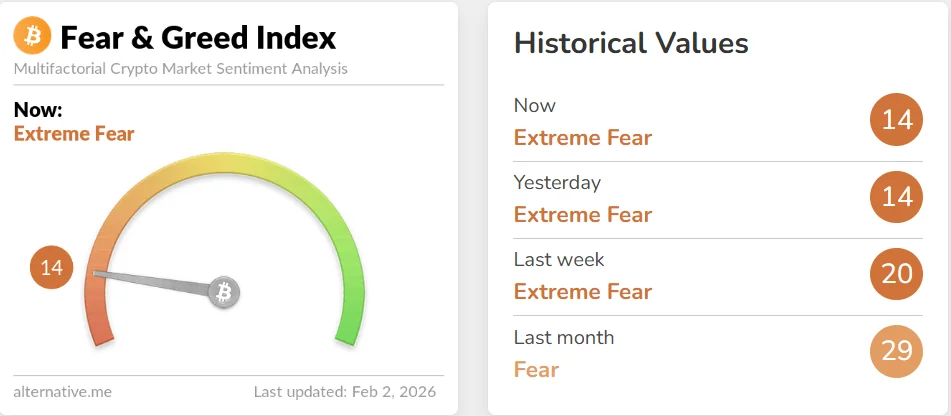
The Bitcoin Fear and Greed Index, a popular gauge of investor sentiment, is flashing extremely negative signals. The index aggregates data from price volatility, market momentum, Bitcoin dominance, and social media activity to assess the community’s emotions.
Price movement and momentum account for roughly 50% of the score, which ranges from 0 (extreme fear) to 100 (extreme greed). As a result, when the market turns sharply lower, the index follows quickly.
Since January 22, when Bitcoin’s correction began, the Fear & Greed Index has remained below 30. After last weekend’s market-wide crash — which wiped out more than $2.5 billion in leveraged positions — the index plunged to 14, its lowest level since mid-December.
Earlier, Bitcoin had briefly recovered to the $84,000 area following Thursday’s sell-off, but it then suddenly dropped to $75,500, its lowest price since last April. Altcoins followed the move, many posting their weakest levels in more than a year.
A Disaster — or a Hidden Opportunity?
Whenever the Fear & Greed Index enters “extreme fear,” the market tends to split into two camps. One side warns that the downtrend is not over and risks remain elevated. The other views the panic as a potential accumulation opportunity during heavy sell-offs.
Legendary investor Warren Buffett famously advised: “Be fearful when others are greedy, and greedy when others are fearful.” History suggests that many strong Bitcoin reversals have started when investor sentiment hits rock bottom.
“Rich Dad Poor Dad” author Robert Kiyosaki has echoed a similar view. He argues that wealthy investors tend to go shopping when financial markets are “on sale,” while most retail participants panic, sell, and run.
Of course, nothing guarantees that Bitcoin will rebound immediately. Still, extreme fear often signals that the market is approaching a new balance zone, where smart money begins watching closely and gradually accumulating.