

This latest decline marks Bitcoin’s second consecutive month of weakness, reflecting growing investor caution amid uncertain macroeconomic conditions and fading institutional support.
Over the past 24 hours, Bitcoin has fallen by around 2%, now trading 5% below its seven-day high of $89,220 and hovering near the weekly low around $84,600. Trading volume reached $56 billion, while Bitcoin’s market capitalization stands at $1.69 trillion. The circulating supply is approximately 19.96 million BTC, nearing the maximum cap of 21 million.
Short-lived rally following U.S. inflation data

Earlier, Bitcoin staged a sharp rebound from the $86,000 level, briefly challenging $89,000, after the U.S. released lower-than-expected Consumer Price Index (CPI) data for November. Headline inflation rose 2.7% year over year, while core CPI fell to 2.6%, its lowest level since early 2021.
The data fueled optimism that the Federal Reserve could adopt a more accommodative stance in 2026. According to CME FedWatch, the probability of a rate cut by March edged higher, although a January move remains unlikely.
However, the rally quickly faded. Bitcoin failed to break above $90,000 and reversed sharply lower, repeating a familiar pattern of sudden spikes followed by rapid pullbacks.
What is weighing on Bitcoin’s price?
One of the biggest headwinds comes from U.S.-listed spot Bitcoin ETFs. After serving as a major source of demand, these funds have recently recorded net outflows, removing a key pillar of institutional support. Without consistent ETF inflows, sustaining breakouts above the $89,000 level has become increasingly difficult.
Macroeconomic signals remain mixed. U.S. unemployment has risen to 4.6%, the highest since 2021, while job growth remains uneven. These conflicting indicators complicate the Fed’s policy outlook, encouraging a cautious approach despite easing inflation.
Political factors also add uncertainty. President Donald Trump has publicly called for lower interest rates and suggested appointing a more dovish Fed chair. While markets have largely dismissed these comments as noise, they introduce additional variables into the broader macro landscape.
Technical outlook: consolidation within a bearish structure
From a technical perspective, Bitcoin is consolidating rather than trending. Strong resistance has formed just below $90,000, where supply remains heavy from investors who bought during previous rallies.
The Bitcoin Fear and Greed Index currently sits at 17/100, signaling extreme fear. Historically, such low readings have coincided with periods of undervaluation, attracting contrarian buyers—although overall sentiment remains cautious.
Meanwhile, Bitwise recently suggested that Bitcoin could break away from its traditional four-year cycle, potentially setting new all-time highs in 2026, accompanied by lower volatility and reduced correlation with equities.
Is $70,000 coming next?
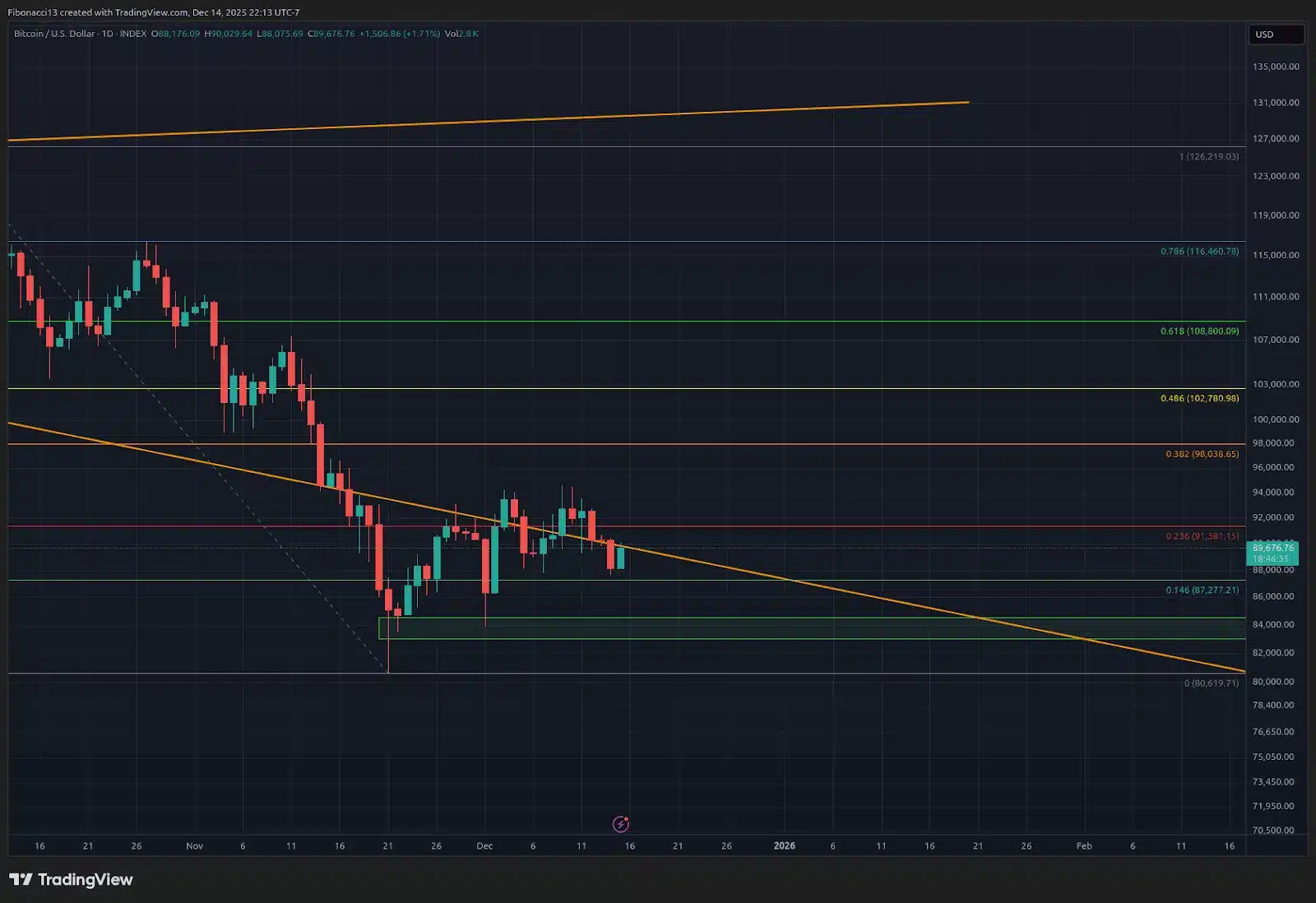
According to technical analysts, the $84,000 support level is under significant pressure. A decisive break below this zone could open the door to a deeper pullback toward the $72,000–$68,000 range. While short-term bounces are likely, insufficient buying strength could ultimately drive prices closer to $70,000.
On the upside, major resistance extends from $94,000 to $118,000, requiring substantial buying volume for bulls to regain control.
In the near term, momentum favors sellers. Bitcoin closed last week’s candle in the red and failed to hold above $94,000, leaving bears well-positioned to push prices lower in the days ahead.
At the time of writing, Bitcoin is trading at $84,812, with $56 billion in daily trading volume and a market capitalization of $1.69 trillion.