
Bitcoin is going through one of its darkest phases since the 2018 “crypto winter.” Over the past 30 days alone, BTC has lost more than 13% of its value, dragging market sentiment into the “Extreme Fear” zone. The big question now is: where is Bitcoin’s next bottom?
The past weekend was especially brutal for risk assets. Bitcoin plunged below the $80,000 mark, briefly touching lows near $74,500 before rebounding modestly to around $78,500. This marked BTC’s fourth consecutive monthly decline — the longest losing streak since 2018.
The sell-off was triggered by a “perfect storm” of macroeconomic turmoil. U.S. President Donald Trump’s renewed tariff threats sent investors fleeing from risky assets. Within just 24 hours on January 30, more than $2.2 billion worth of leveraged crypto positions were liquidated, with long traders taking the hardest hit.
Unsurprisingly, the Fear & Greed Index has now dropped to 14, firmly in “Extreme Fear” territory. What’s notable is that even traditional safe havens failed to provide protection. Gold tumbled more than 12% from record highs above $5,500 to below $5,000, while silver collapsed by as much as 30%, marking its worst session since 1980. Investors appear to be selling everything in a rush for U.S. dollar liquidity.
Still, the market is showing some green candles today. Most of the top 100 cryptocurrencies by market cap are posting small rebounds. The key question remains: is this the start of a recovery, or just a brief pause before another leg down?
Technical outlook: Bearish, but oversold
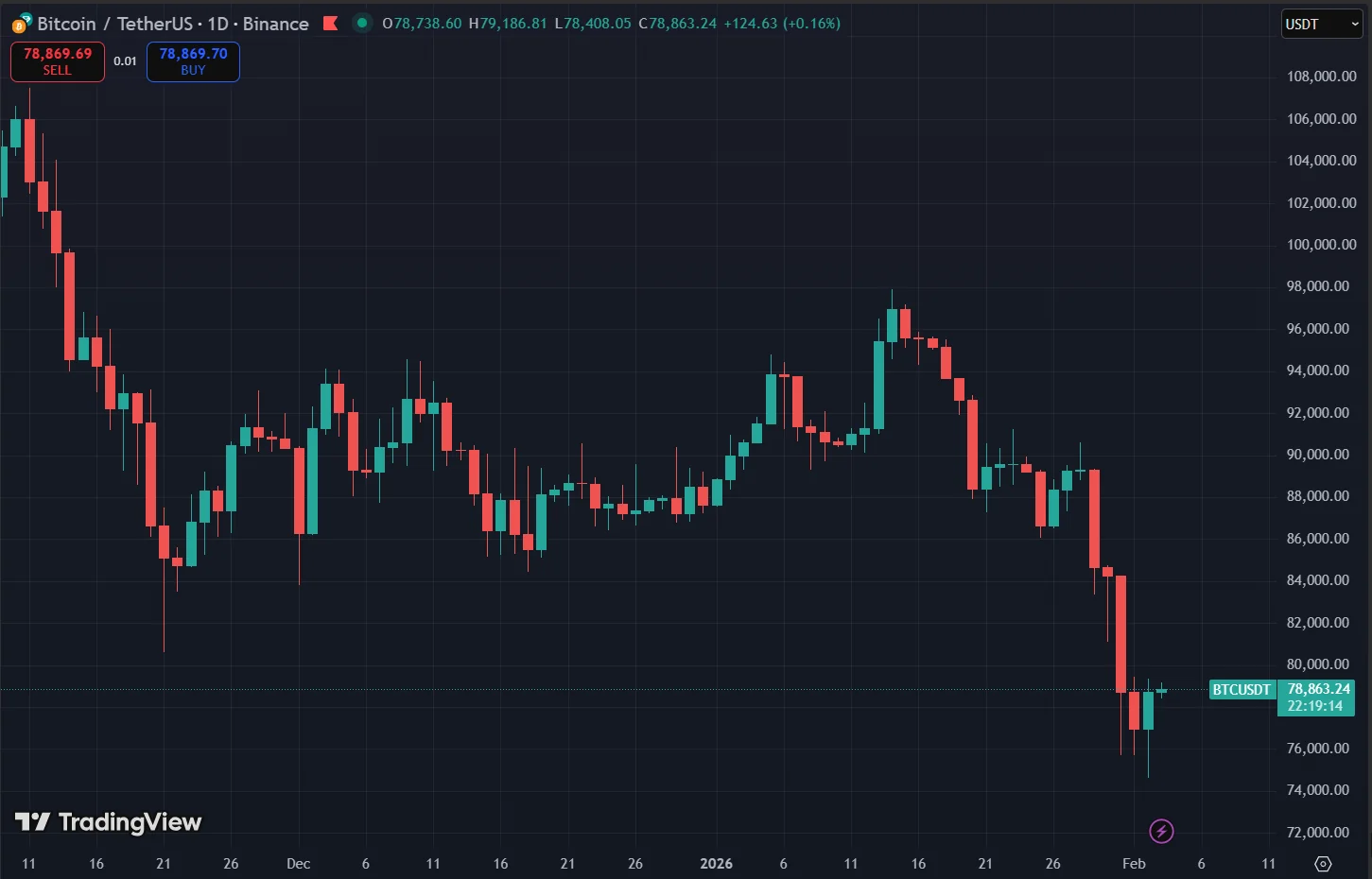
Bitcoin is currently trading around $78,800, up about 1% over the last 24 hours. However, technical indicators continue to point to a dominant downtrend.
On the daily chart, the Exponential Moving Averages (EMAs) remain firmly bearish. The 50-day EMA sits below the 200-day EMA, confirming a medium-term downtrend and signaling weak short-term momentum.
The Average Directional Index (ADX) stands at 32.1, above the key threshold of 25, which indicates a strong trend is in place — and unfortunately for bulls, that trend is still pointing lower.
One of the few “hope” signals comes from the Relative Strength Index (RSI), which has fallen to around 30, placing Bitcoin in oversold territory. Historically, such readings often precede technical relief rallies, though they do not guarantee a full trend reversal.
On the four-hour timeframe, Bitcoin has bounced from the $74,000–$74,500 support zone and attempted to retest the EMA cluster. However, upside momentum remains weak, while ADX is extremely elevated at 57.4, suggesting the short-term downtrend is still very strong.
Key price levels to watch
The $74,000 zone has proven to be a critical support area. If BTC can hold this level on a retest, the market may consolidate in the $78,000–$85,000 range.
If Bitcoin breaks below $74,000, the next major target comes in near $69,000 — representing roughly a 45% correction from the $126,000 peak seen in October.
On the upside, $80,600 acts as the nearest resistance. A daily close above this level would be the first signal that bears are losing control. Beyond that, the $91,300 area — where EMA resistance and prior support converge — will be a formidable barrier for any recovery attempt.